

KNITTING PROJECT
By Manuela Romero Moreno
IDEAL PRODUCT CRITERIA
Stitches are not too tight or too loose.
Cable pattern is consistent in design.
Sleeves are 4/4 long and are not too loose or too tight for my arms.
Bottom of the sweater reaches my waist.
Neck of the sweater has a noticeably finished pattern.
Yarn ends are unnoticeable when seeing and wearing the sweater.
Sweater stretches evenly on both sides and back.
PLANNING THE PROCESS
The first plan for a product I came up with was a form of the korean martial art Taekwondo called Poomsae. This is because I have practiced the sport since I was 7. Then, during summer, I considered knitting since, out of fun, I was making small projects like bralettes to sell them and thought of making a bigger project that required more skill and time. The research question for this initial product was "How can I make my own Poomsae?". The current and final research question for the sweater is "How does knitting a sweater improve crocheting skills?" and the global context is 'Personal and Cultural Expression'.
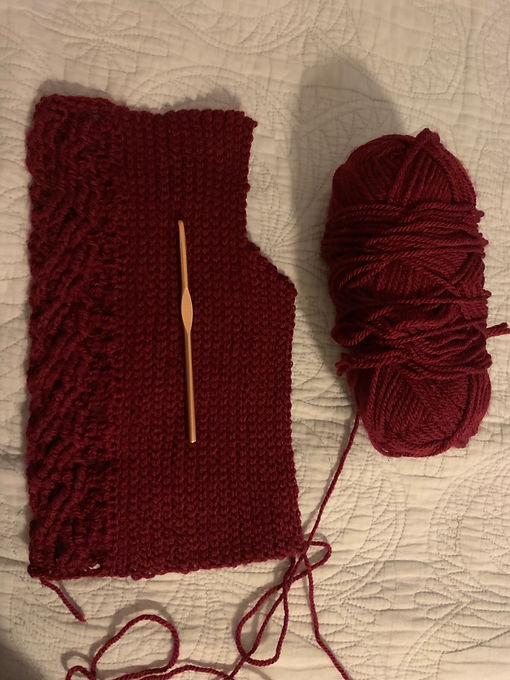
.Planning the stitches and design the sweater should have took extensive hours of research on different sources and carrying out interviews with relatives and knitters. I looked into different patterns and stitches that could make the sweater look and be comfortable until I found out that a slip stitch can be stretched more than double its size when back-loop knitted. I decided for a cable pattern in the middle to give it an interesting factor that will bring more attention to it rather than the flat, stretching sides.
The main obstacles I encountered while making my product was the stretching stitch, choosing of yarn and hook size, and the making of the cables:
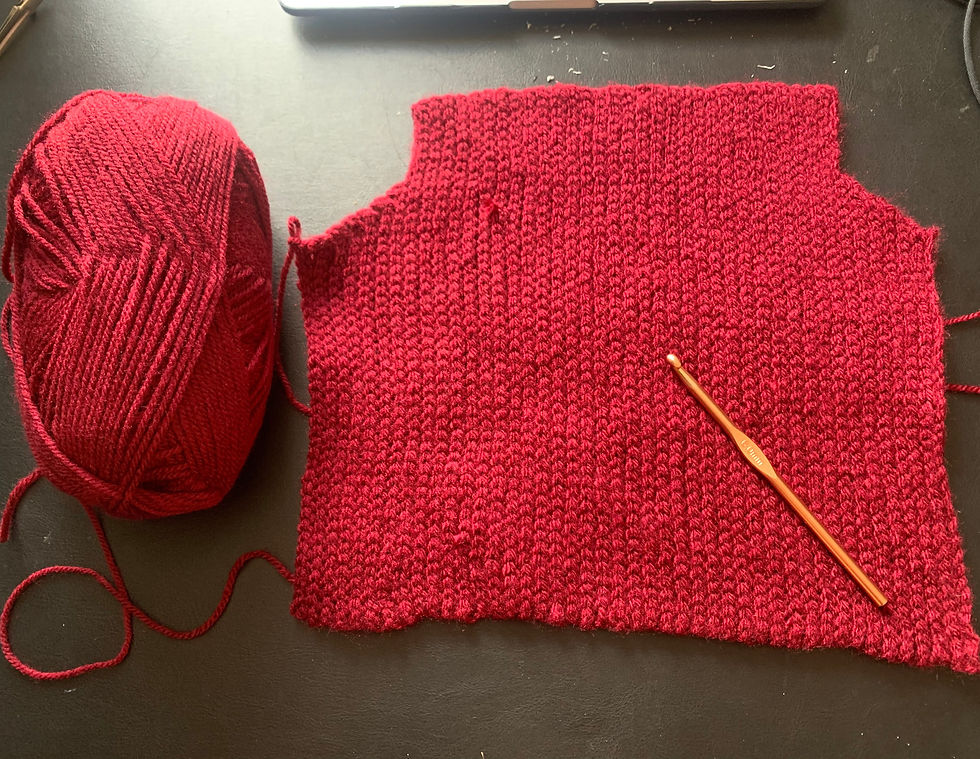
The stitch that stretches had to be crocheted in a specific way; the yarn should only pass through one loop of yarn when there is two. For the frontal part of the sweater I was not able to crochet every single stitch perfectly. For the back part I had to undo and redo at least 3 times. That gave me practice and I was able to finish the back part without any mistakes.
Choosing the right thickness of yarn and the size of the hook took three balls of yarn and two hook sizes, meaning I had to restart the cables and some part of the stretching side at least 3 times.
Crocheting the cables was the most difficult part because it was not only about the yern going through a specific loop but also holding several loops of yarn and positioning the hook and fingers in such a way that the loops won't fall out.

PERSONAL INTEREST
I have knitted and crocheted for some years now but I had never tried making a project bigger than a simple pattern to make a crop top or a simple stitch to make a blanket. A bigger project that would take longer to make and have more difficult patterns was an appealing idea and I decided to follow it.
I began knitting because my grandmother and mother do so as well. When I started I found it relaxing and it helped with my nerves and anxiety. I usually crochet and knit during my free time because it is a mechanical activity that helps me focus and channel thoughts in a different way; when I am calm it is easier to process complex information.
I used my basic skills as Service Action for MYP4 last year; I knit a blanket with a thick pattern for dogs and cats in a shelter. I also enjoy knitting blankets for my dog as personal projects. Making dog sweaters is an activity I found enjoyable and it comes with the immediate satisfaction that my dog will have some use for them. I also make the crop tops to sell them, you can find me in instagram as @oarfish_crochet
Developing fine motricity is also a benefit of crocheting, this can help improve handwriting and steadiness of the hand.

ABOUT THE PROCESS
My first ball of yarn was a think pink yarn; it turned out to be too thin so I decided to change to a thicker yarn. The first hook size I used was a 3.5mm, it was also too small which did not allow for the yarn to stretch enough because the stitches were so close and tight. The second ball of yarn I used was only slightly thicker than the first one, which meant that the change of thickness was not considerable and I obtained the same results since I also used the same hook size. The third decision was a maroon ball of yarn with a 7-8mm thickness; although I did make a mistake: I used the same hook size. I had to undo more than half the frontal part because of this and had to restart the entire project once again. The fourth and final decision was to use a 6mm size hook which gave the perfect looseness to the yarn.
I also had trouble knitting the cables; the yarn over the hook was very slippery because of the technique. I had to restart it several times since I had made visible mistakes and the pattern was not looking neat.
I restarted the stretchable back part twice because the sleeve holes were not aligned with the front part. I also made a couple mistakes when trying to loop through a single loop of yarn which defeated the stretching purpose; I had to go back and fix those mistakes.


